Save My Exams vs Lumi: notes you read, or a tutor you talk to
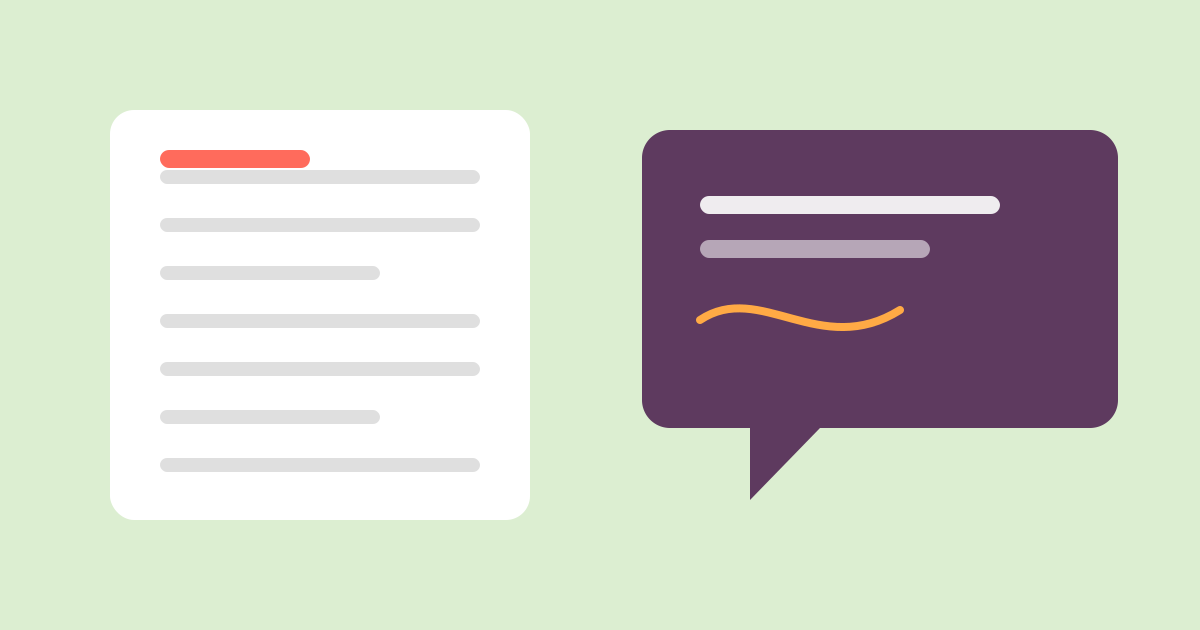
Save My Exams is a subscription library of revision notes, topic questions and mark schemes organised by exam board, written to be read. Lumi is an interactive AI tutor you hold a conversation with, built for the point where reading has stopped working. If you learn well from well-organised written notes, Save My Exams is excellent. If you read a page three times and still cannot picture it, an explanation you can interrupt is worth more.
Save My Exams occupies a specific and genuinely useful spot: revision notes and exam-style questions, written by people who know what examiners reward, filed by exam board and topic so you can find the exact thing you need. If your problem is that your own notes are a mess and the textbook takes nine pages to say something that needs one, it solves that problem properly.
What Save My Exams does well
- Notes written to the specification rather than to a general syllabus, so you are not revising content your board does not assess.
- Topic questions with mark schemes, which is the fastest way to find out whether you can actually produce an answer.
- Concise. The editing is the product. Somebody has already decided what matters.
- Well organised. Finding the right page takes seconds, which matters more than it sounds when you have two hours and four topics.
- Written by teachers and examiners, so the emphasis tends to match where the marks are.
The limit of a written note
A note is a broadcast. It was written once, for everybody, by someone who could not see your face. That is fine when the gap between what you know and what the note assumes is small. When it is large, the note has no way of finding out.
Every student has had this experience. You read the explanation. You understand each sentence individually. You get to the end and you still could not do the question, and you cannot say which sentence lost you. Reading it again more slowly does not help, because the problem is not speed. Something the note took for granted is missing, and the note cannot ask you what.
The gap is rarely in the topic you are revising. It is usually two topics further back, in something everyone assumed you already had.
What Lumi adds
Lumi is the other half of that. You say what is not landing, and it works back to the step you actually lost before it starts explaining. Then it explains while drawing on a whiteboard, so an abstract process becomes something you can see happening. You can stop it mid-sentence. You can say that made no sense. You can ask for it with smaller numbers, or as an analogy, or with the diagram drawn again more slowly.
You can attach the thing you are stuck on — a past paper, a page of your own notes, a photo of the question — and work through it together rather than reading someone else's summary of it.
Side by side
| Save My Exams | Lumi | |
|---|---|---|
| Format | Written notes and questions | Spoken or typed conversation |
| Direction | One way: you read | Two way: you ask, it answers, you push back |
| Diagrams | Illustrated in the notes | Drawn live and open to questions |
| When it shines | You know what you need and want it stated cleanly | You cannot work out what you are missing |
| Exam questions | Topic questions with mark schemes | Generates questions and marks your attempt |
| Your own material | No | Attach notes, PDFs, photos and past papers |
| Free option | Limited free access | 3 lessons, up to 10 minutes each |
| Paid | Subscription | Plus at £28 a month |
Using them together
This is the honest recommendation, and it is not a fudge. They are complementary in a way that Seneca and Save My Exams are not, because one is a reference and the other is a conversation.
- Read the note first. It is faster than having anything explained from scratch, and for most topics it will be enough.
- Mark the bits that did not land. Be specific: not 'kinetics' but 'why the rate-determining step is the slow one'.
- Take exactly those to Lumi and have them drawn out until you can say them back.
- Do the topic questions and mark them against the scheme.
- Anything you dropped marks on goes back to step three.
One thing neither of them replaces
Sitting a full paper, timed, in one go, and marking it honestly. Revision resources are for building the knowledge. Past papers are where you find out whether you can retrieve it under pressure with a clock running, which is a separate skill and the one the exam is actually testing.
What to take from this
- Save My Exams is a reading and practice resource, organised tightly around exam specifications.
- Its topic questions with mark schemes are its strongest feature and the reason most people subscribe.
- Reading is a one-way channel. When a note does not land, there is nowhere to take the confusion.
- Lumi is two-way: you ask, it draws, you interrupt, it tries a different angle.
- They combine well. Read the note, and take whatever did not stick to something that can answer back.
Questions people also ask
If your own notes are patchy and you want spec-accurate summaries plus topic questions with mark schemes, it does that job well and saves a lot of time. If you already have good notes and your problem is understanding rather than organisation, it will not fix the thing that is wrong.
It will summarise what you covered in a session, but it is not a notes library. It is built around the conversation, so think of it as the person you ask rather than the page you read.
It will mark an attempt and show you where the marks were available and why you did or did not get them. Attach the real mark scheme and it works to that.
For cramming content you have already met, well-organised notes are faster. For the topic you have avoided all year and now have to face, an explanation you can interrupt will get you further in the same hour.
Both organise around the main UK boards. Check that your specific board and specification are covered before you subscribe to anything, since coverage differs by subject.